
In July 2026, the United Nations reported that looted gold and looted gum arabic are helping bankroll Sudan’s civil war, moved through opaque channels into international supply chains (OHCHR, 2026). For a buyer’s due-diligence team, asking where a shipment of gum arabic actually originated is no longer a formality to tick on a certificate — it is the question. Sudan once supplied 70 to 80 per cent of the world’s volume; since the war began in 2023, sourcing that volume without financing the conflict has become the industry’s defining problem.
A market repriced, not broken
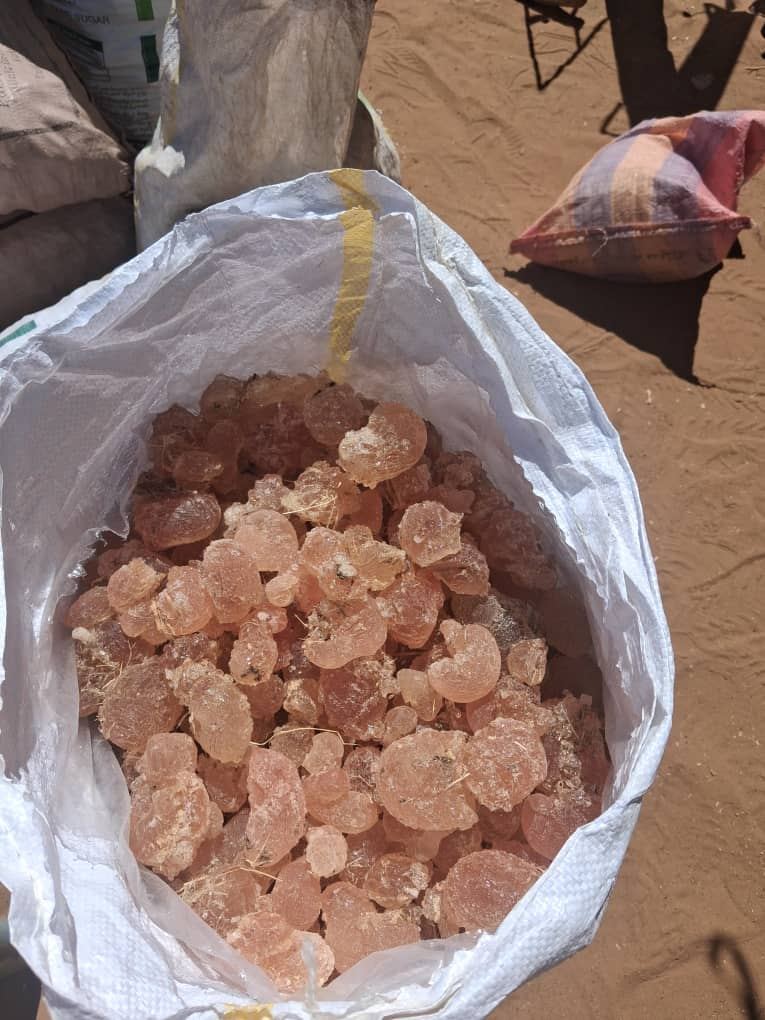
The disruption is logistical and documentary as much as agricultural. The Sudanese acacia belt still produces; what has become difficult is moving gum through channels that a quality or compliance team can verify. In West Kordofan, the Rapid Support Forces looted the Gum Arabic Exchange and warehouses in El-Nuhud, and at least 3,700 tonnes moved through undocumented channels between January and June 2024 alone (OHCHR, 2026). Some of that looted gum is reported to be trafficked onward through South Sudan and through Chad itself before reaching processors abroad (UN News, 2026). We are direct about what that means: MAMO condemns conflict-financed gum without qualification, and the fact that some looted Sudanese material transits Chadian territory is exactly why documentation has to work at the level of the collection zone, not the country printed on a certificate. Volumes continue to reach the market by other routes, but chain of custody on those routes is hard to establish — precisely the property buyers now need most.
Prices tell the story soberly. Export prices moved from around $1,800 per tonne in 2022 to around $3,000 per tonne in 2024–25. By the time gum reaches the destination warehouse, with freight, insurance and intermediation added, the average import price stood near $5,280 per tonne in 2025. By 2026, industry trackers place gum arabic anywhere from roughly $2,700 to $8,000 per tonne depending on grade and processing, with technical-grade material averaging near $3,200 per tonne, and size the global market at close to $718 million, projected to approach $1.47 billion by 2034 (Tridge, 2026). Two conclusions follow. The repricing is structural, reflecting a supply base under stress rather than a speculative spike. And the spread between origin and delivered prices rewards shorter, better-documented chains.
Origin security reaches the boardroom
For a measure of how seriously the industry takes this, look at what processors do rather than what they say. In July 2026, Nexira announced its acquisition of Keragum and presented the operation as securing “direct access to raw materials at origin”. When a leading processor frames an acquisition in those terms, origin security has moved from the procurement department to the boardroom. Buyers who cannot acquire their way upstream will need the contractual equivalent: suppliers who are already there.
Chad’s position
Chad is the world’s second producer. It exported roughly 61,600 tonnes in 2025, up 8 per cent on the previous year — growth achieved while the wider market was under strain. The gum belt across Ouaddaï, Salamat and Chari-Baguirmi yields both Acacia Senegal and Acacia Seyal, the harvest runs from November to March, and the export corridor through Douala is stable and open to inspection.
None of this is an argument against Sudanese gum, which remains essential to the market and will return in force as conditions allow. It is an argument for balance, sharpened by reporting that has traced in detail how gum arabic revenue has become entangled with financing for the war itself (Al Jazeera, 2026). A buyer whose supply plan depends on a single, undocumented origin is carrying a risk that 2023 showed to be real; a buyer with a qualified, documented second origin is not.
What a documented origin actually solves
Scarcity and compliance are usually managed as separate risks by separate teams. A documented Chadian origin addresses both at once. On volume, it adds a growing source and reduces dependence on any single country. On compliance, GPS-mapped collection zones, lot-level independent analyses and a complete documentary file per container give due-diligence teams what they increasingly cannot work without: an origin that can be shown, not merely declared.
The practical conclusion is unglamorous. Qualify a second origin before you need it — samples, analyses, then a trial container, ideally ahead of the November harvest. The buyers best placed for the coming seasons will be the ones who did the paperwork in calm weather.
Sources
NEXT STEP
Questions on your own supply plan? We answer in plain terms, within 24 hours.