What the EUDR actually covers
Gum arabic does not appear on the European Union Deforestation Regulation’s list of covered commodities. Yet in 2026, a buyer who cannot show where their gum arabic grew still has a problem, because the standards around it have moved regardless of the list.
The EU Deforestation Regulation (EUDR) covers seven commodities: cattle, cocoa, coffee, palm oil, rubber, soy and wood, along with a defined set of derived products (European Commission, 2026; WRI, 2026). Gum arabic is not among them. The regulation requires operators placing these goods on the EU market to provide precise geolocation of production plots and to demonstrate that the goods are deforestation-free after the cut-off date of 31 December 2020. It applies from 30 December 2026 for large and medium operators, and from 30 June 2027 for micro and small operators. On 13 July 2026, the European Commission adopted a Delegated Act updating the product scope and simplification measures, alongside an Implementing Act for the due-diligence information system (European Commission, 2026).
Why documented origin matters anyway
Being outside the EUDR’s list does not put gum arabic outside scrutiny. Two separate pressures now converge on the same requirement: documented, geolocated origin.
The first is the direction of travel. The EUDR sets an expectation of geolocated, deforestation-free due diligence across soft commodities, and European compliance and procurement teams increasingly apply that same discipline to products outside the regulation’s formal list, as a matter of internal policy rather than legal obligation.
The second is more immediate. In July 2026, the United Nations reported that looted gold and gum arabic from Sudan are helping finance the country’s ongoing conflict (UN News, 2026). For buyers, that finding turns origin documentation from a compliance nicety into a basic question of conflict-free sourcing. A trading house able to show precisely which zone a lot came from, and that the zone is not implicated in the conflict economy, answers a question that increasingly matters regardless of what the EUDR’s commodity list says.
Tapping, not felling
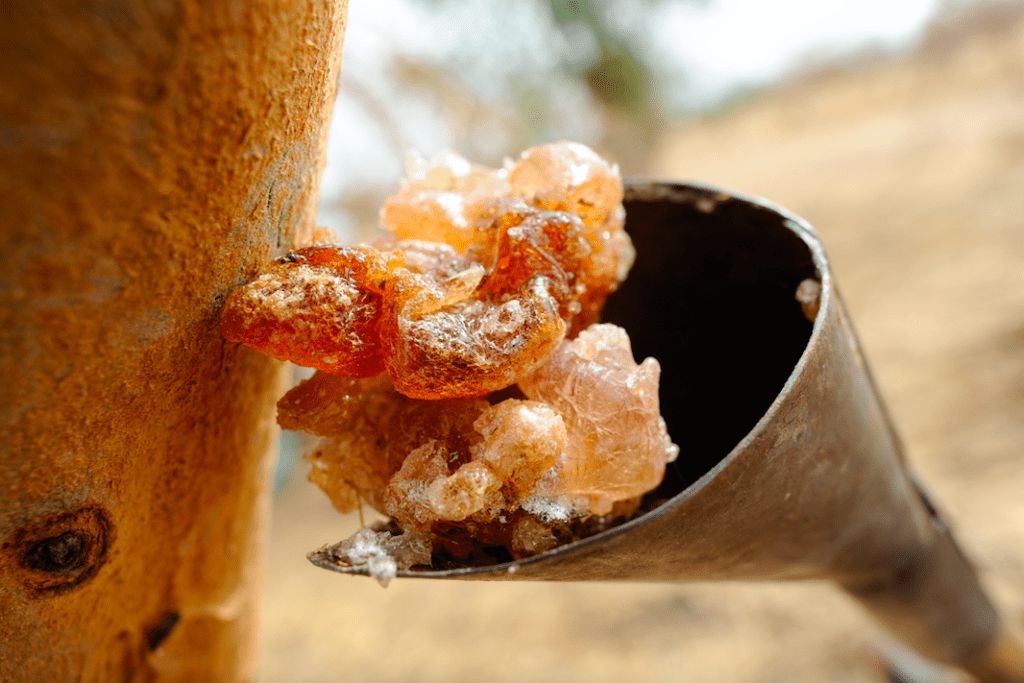
The underlying biology works in gum arabic’s favour. Collection is tapping, not felling: a shallow incision on the trunk and branches triggers the acacia’s natural exudation; nodules cure in the open air and are hand-collected weeks later. The tree is unharmed and continues producing for decades. Because the gum itself gives the standing tree its economic value, this is one of the few commodity chains where the incentive runs toward keeping trees alive rather than clearing them — a direct link to anti-desertification efforts in the Sahelian belt, in the very corridor of Africa’s Great Green Wall, and a deforestation-free story that can be documented, not merely asserted.
MAMO’s practice: documented containers
MAMO International applies the same documentation discipline to every container, whether or not gum arabic sits inside the EUDR’s list. Each collection zone is GPS-recorded before harvest; each lot carries photographs from collection through sorting; and each shipment leaves N’Djamena with a complete documentary file rather than a certificate of origin alone. This is not a claim of EUDR certification, which does not apply to gum arabic, but a working practice built for what buyers’ compliance teams and conflict-free sourcing checks now ask for. The file travels with the shipping documents rather than as a separate add-on, so a buyer’s compliance team can fold it directly into its own due-diligence or sourcing-verification records without chasing paperwork after the container has sailed.
As good practice — not an EUDR legal obligation for gum arabic — a buyer’s file for a container of Chadian gum arabic should contain:
- 1Geolocation of the collection zone(s), recorded before harvest
- 2Dated photographic record of collection and sorting, attributable to the lot
- 3Independent laboratory analysis certificate for the specific lot shipped
- 4Certificate of origin issued at the point of export
- 5A signed attestation of deforestation-free sourcing from the supplying trading house
None of this brings gum arabic under the EUDR. It does mean that buyers who ask for this file today are already positioned for whatever the regulation’s scope becomes, and already answer the conflict-free origin question that matters now.
Sources
- 1European Commission — “Regulation on deforestation-free products”
- 2European Commission — “Commission updates product scope and tools to support EUDR” (13 July 2026)
- 3World Resources Institute — “What is the EU Deforestation Regulation (EUDR)?”
- 4UN News — “Looted gold and gum arabic are bankrolling Sudan’s war, UN warns” (July 2026)
This note is general information, not legal advice.